
Closing the Loop on Construction Waste Through Industrial Symbiosis
The Construction and Demolition Waste and Industrial Waste Symbiotic Flows pilot addresses one of the most material-intensive and carbon-intensive waste streams in cities: Construction and Demolition Waste (CDW), together with associated industrial residues such as metals and glass. The pilot demonstrates how urban “rubble” can be transformed into high-performance circular construction materials through advanced sorting, industrial upcycling, and cross-pilot symbiosis.
The problem
Construction and demolition waste is one of the largest waste streams generated in European cities, accounting for approximately 30-40% of total solid waste by volume. While many CDW fractions are theoretically recyclable, in practice large portions are downcycled, landfilled, or used in low-value applications such as road sub-base or backfilling.
Across Europe, key challenges include material heterogeneity, contamination, and quality variability, which limit the reuse of CDW in structural construction applications. As a result, cities continue to rely heavily on virgin raw materials, embedding significant carbon emissions in the built environment.
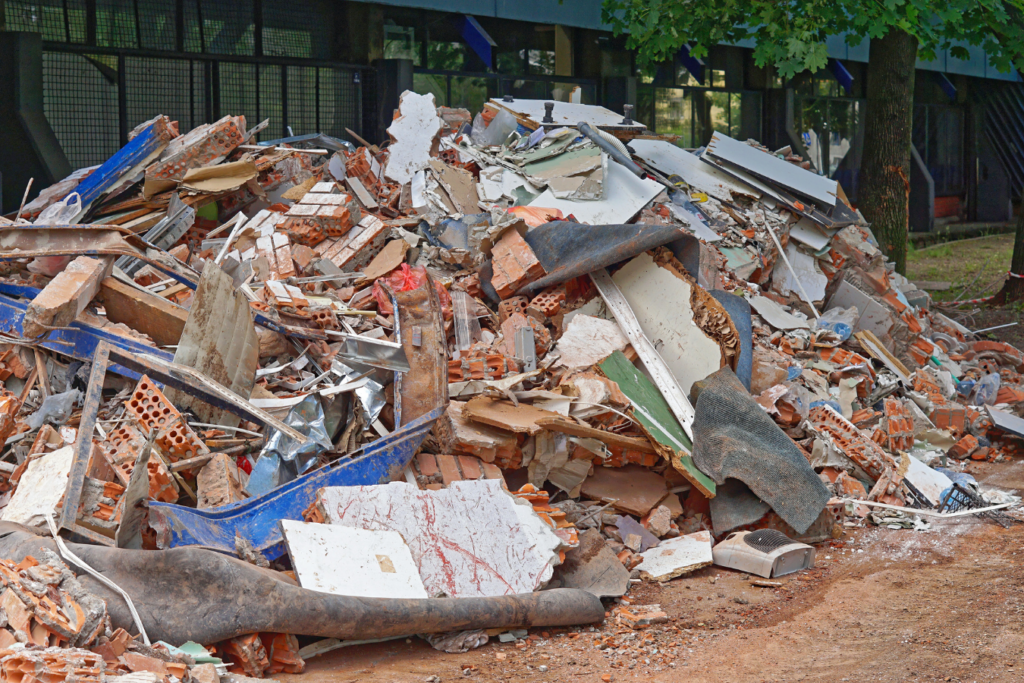
These challenges are particularly pronounced in national contexts where separation infrastructure and valorisation pathways are limited. In Greece, recovery rates for CDW remain relatively low, with estimates ranging between 12–15% and 30–35%, and only a small share of recovered materials is effectively reused in high-value construction products. CDW typically consists of a complex mix of concrete, bricks, wood, metals, glass, and plastics. Existing facilities largely focus on the mineral fraction for low-grade uses, while valuable metals and glass are often lost or transferred without targeted valorisation. Additional barriers include:
- Sorting limitations: Recovering specific metals, such as copper, from mixed CDW is challenging due to impurities and the limited ability of standard sorting technologies to distinguish metal grades. Similarly, glass recycling struggles to differentiate between reusable containers and material suitable only for crushing and remelting.
- Material quality constraints: Variations in chemical composition and mineralogy make it difficult to use recycled CDW in new bricks or concrete without compromising mechanical performance and durability.
What THESEUS is doing
THESEUS is establishing a comprehensive sorting and upcycling ecosystem that reconnects urban demolition flows with industrial manufacturing, involving major industrial partners such as HALCOR, Athenian Brewery, and KEBE.
- Advanced sorting of metals and glass:
- Metals: At HALCOR facilities, the project expands an advanced sorting line using X-ray based and machine vision systems. These technologies detect and grade specific metals, such as copper, from mixed CDW streams, with robotic arms selectively extracting valuable fractions with high precision.
- Glass: At Athenian Brewery, a tailor-made line applies machine vision techniques to returned bottles, distinguishing intact containers suitable for sterilisation and refilling from damaged ones directed to recycling. This optimises reuse loops higher up the circularity hierarchy.
- Upcycling into construction materials:
- Bricks: Refined CDW and pulverised waste glass are used to replace 10–50% of clay-based raw materials in brick production at KEBE facilities.
- Concrete and insulation: Partners including Technical University of Dresden, SINTEF, and Fibran develop concrete mixes targeting strengths of 30–50 MPa and insulation panels combining recycled CDW, waste glass, and fibres sourced from Pilot 1 textiles. These materials are suitable for pre-cast and additive manufacturing applications.
The pilot applies cross-pilot symbiosis and whole-fraction valorisation to maximise material recovery across construction and industrial waste streams.
- Symbiotic feedstock use: This pilot doesn’t just treat its own waste; it absorbs waste from other streams. For example, flame-retardant spun fibers created from textile waste in the Textiles Pilot, are used as secondary reinforcement materials in the construction products of this pilot.
- Whole-fraction valorisation: Unlike traditional recycling, the pilot aims to utilise both fine and coarse CDW fractions in new products, minimising residual waste.
- Negative sorting for reuse: In the glass value chain, the pilot introduces a specific innovation in “negative sorting”, identifying defects (cracks) to remove damaged items so the rest can be reused (refilled) rather than just crushed and melted (recycled), which is higher up the circularity hierarchy, and thus achieving higher circularity performance.
Expected outcomes and impact
The pilot aims to prove that recycled construction materials can meet strict safety and performance standards.
- Performance validation: The new bricks and concrete will undergo rigorous testing for mechanical strength, water absorption, and durability (resistance to frost, chlorides). Crucially, they will be tested for environmental acceptability (leaching tests) to ensure no dangerous substances leak into the soil or water.
- Capacity targets: The pilot aims to demonstrate pathways to increase the recycling rate of targeted CDW streams to around 50%, with the potential to divert tens of thousands of tonnes of construction and demolition waste from landfills when deployed at scale.
- Product prototyping: The final output includes validated prototypes of bricks with high recycled content and energy-efficient insulation panels ready for market evaluation.